

 The mind is a vehicle for your active thinking processes, and it has a source beyond the ever-changing and elusive nature of your thoughts. Call it consciousness or your soul or your timeless sense of Self. Said another way, the mind is a collection of your unique, personal experiences within the fabric of the entire Universe. It’s a field of awareness that creates sensations, feelings, and ideas that make up your reality. The best part is you can harness the power of the mind to craft a joyful, satisfying, and meaningful life with purpose.
It makes sense that the mind is the activity of thought. We spend a lot of time in our heads, right? This is a wonderful thing because it allows us to travel through time and imagine beyond what we experience with the senses. The mind can slow down our perception of time, allowing us to savor the moment. It can also keep us in sync with the people and world around us.
Yet there are times when the flipside of these perks rears its ugly head. We get stuck in the past, playing a never-ending loop of regrets, wishing we had done or said something different. Or, we forget our connection to the infinite stream of love and try to think our way into a future solution (one that we can’t yet see or access from our sense of separation).
Thankfully, scientific advancements are starting to highlight the seamless flow of consciousness and our biology. We’re learning how our thoughts literally change our brain functionality, protein production, and gene expression. We’re also starting to understand the physiological mechanisms of the brain that allow us to direct our focus in a more deliberate way.
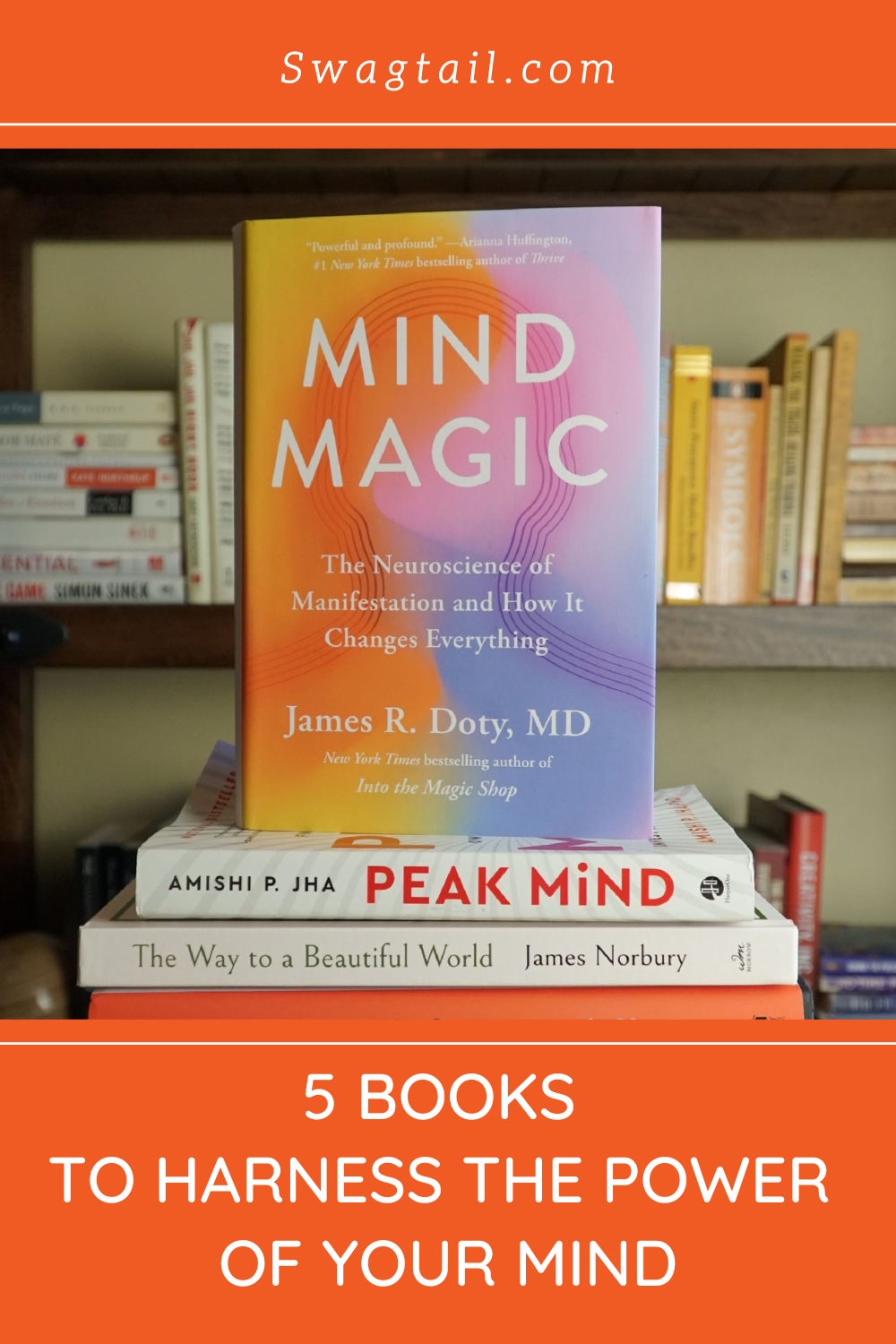
The five books mentioned below are great resources for illustrating these points. Plus, they provide tangible and entertaining ways to flow with the mind for greater autonomy, focus, and inner peace.
MIND MAGIC
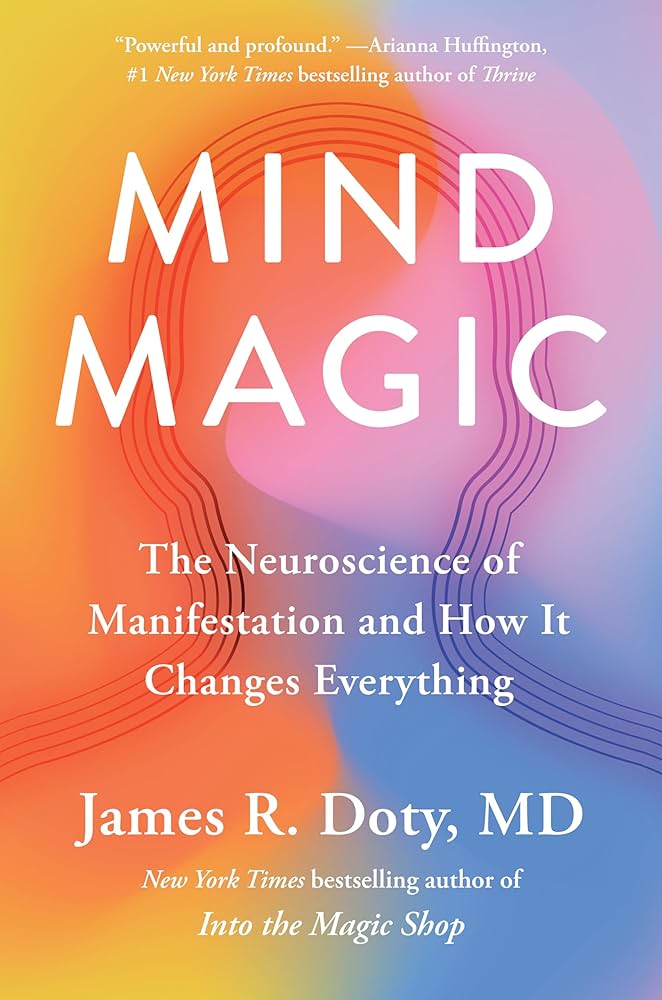 Manifestation is a common term used today to describe the act of turning thoughts into things. In Mind Magic, Dr. James Doty uses neuroscience to break down this process. He shares how the four large circuits of the brain work together to bring ideas into reality. First, we have the default mode network for self-referential processing. Then there is the salience network that helps us determine what’s important, and the attention network within it that determines how we focus. Finally, the central executive network is responsible for our working memory, decision-making, and problem-solving as we pursue a goal.
While these terms may sound complex, Dr. Doty breaks the manifestation process down into six simple steps that fine-tune these networks for greater life success.
My Favorite Part
My favorite part of Mind Magic is how mental training is approached as a lifelong practice. Just as we use yoga postures and breathing techniques to balance the body, this book provides specific, repeatable techniques to refine your attention. This is important because we must rehearse new mental patterns over and over again to get results. Otherwise, the brain rejects new ideas in order to do its job of conserving energy.
Research today shows that deep experiences of positive emotion can be generated in the mind, and these imagined experiences appear just as real to the body as actual experiences. As we practice the future we desire, we teach our subconscious to associate with those desired outcomes. Those neural pathways become hardwired in the brain, and we absorb that inner vision as a known state. Better still, the mind then does its job to forage the surrounding environment for opportunities and people that match our intentions.
Quotes about the Power of the Mind:
- “Manifestation is about cultivating a fierce belief in possibility.”
- “It is the underlying state of our physiological processes that determines the quality and stability of the feelings and emotions we experience.”
- “Positive emotions activate the reward systems of our brains and therefore keep our inner compass set towards our intentions.”
- “Only when we believe we are enough in ourselves do we find the ability to contribute to life, and only in the contributing to our world do we discover that we are inherently enough.”
PEAK MIND
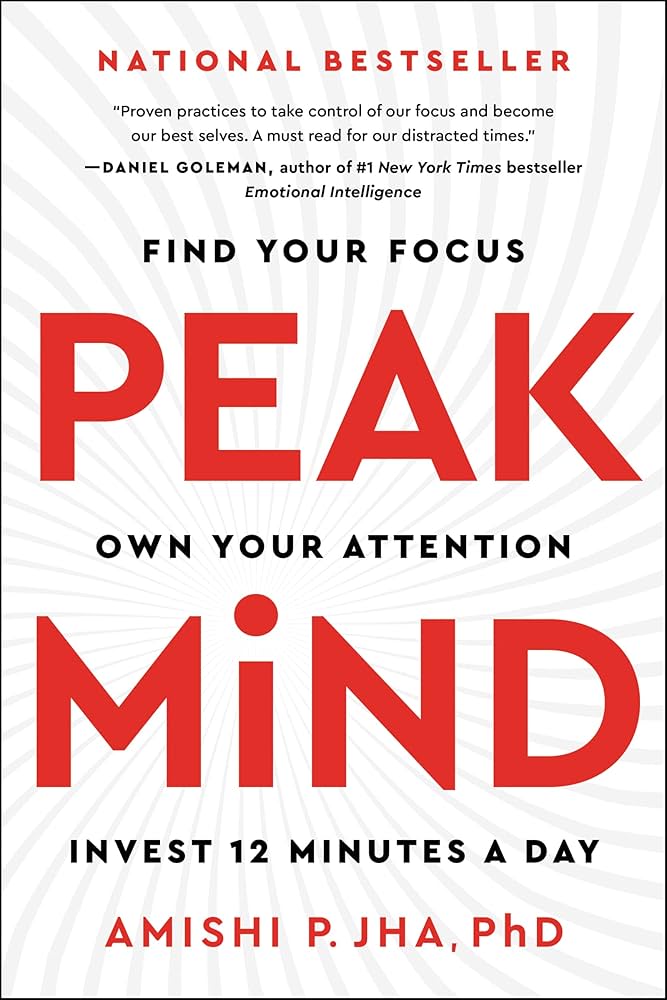
While Mind Magic explains how the different networks of the brain collaborate for us to think on purpose, it only briefly touches on the attention network. Peak Mind does a brilliant job of describing it in depth. In fact, Dr. Amishi Jha, of the University of Miami, explains how attention is our energetic currency. She describes attention as our superpower. It’s the force that shapes our lives, determines our levels of reactivity, influences our decisions, and impacts the quality of our relationships. Plus, attention prevents us from being overwhelmed with the incessant stream of data that bombards us every single second.
Your Mind is Powerful, but it’s Also Vulnerable
There are lots of forces that can degrade our attention. Stress, such as high cognitive demands, tense social interactions, and a general sense of uncertainty, is the first to undermine our focus. Negative emotions, or poor moods, are the second. The third is a sense of being threatened. Whether we perceive our security is under attack or we’re physically in danger, it can be impossible to focus on the task at hand.
The good news is that the mind is also trainable. We can develop the ability to stay in the present without judging or editorializing the experience. And, as Dr. Jha’s studies confirm, we can harness the power of our mind in as little as twelve minutes each day.
Quotes About the Power of Your Mind
- “What you pay attention to is your life.”
- “If you engage in mindfulness training or presence training, you will feel better, but not simply from the practices alone. The practices will build your attentional capacity, and that will help you fully experience moments of joy, thrive in demanding circumstances, and successfully navigate moments of crisis with a reservoir of resilience.”
- “The instructions [for a peak mind] are informed by current science on behavior change: Start with extremely small goals, achieve them, don’t miss out on the feel-good sense of success (this is key!), and repeat.”
STRONG GROUND
 Whether you’re a fan of Brené Brown’s work or not, her latest book, entitled Strong Ground, outlines how to successfully navigate changes in your business. Brown details several communication and organizational strategies to do this. Plus, she provides an excellent description of what mindsets and emotions are essential to help you thrive during any big transformation. I share my personal take on these insights in greater depth here.
In many ways, finding strong ground is a lot like standing in Tadasana on the yoga mat. You plant your feet evenly into the Earth.
This initiates a ground reactive force by which the floor exerts an equal and opposite reaction force back upward. You have a steady base, energized body, and a resiliency to adapt to the constant stream of changes we encounter on the mat, and in life.
Straddling Paradox
In order to tap into the immense power of your mind fully, Brown talks in depth about embracing paradox. “In its original Greek, paradox is made up of two words,” Brown explains, “para (contrary to) and dokein (opinion). The Latin paradoxum means “seemingly absurd but really true.” It’s the tension that arises when opposite ideas both appear to be valid. This can cause us to mentally shrink away from such uncomfortable moments, or want to pick a side and defend it to the death. Yet the gift of straddling the paradox is that we can more deeply understand ourselves and the world around us. And, even better, fresh perspectives can be born from the space of holding multiple ideas simultaneously.
Quotes for a Strong Mind:
- “Spirituality is recognizing and celebrating that we are all inextricably connected to each other by a power greater than all of us, and our connection to that power and to one another is grounded in love, compassion, and mystery.”
- “The goal is to develop the strength and grounding required to hold the tension of two opposing ideas until a new idea is born, until something more encompassing, more connected and more nuanced emerges.”
- “A contemplative practice helps you hold contradictions without anxiety or the need for immediate resolution.”
- “Spirituality can’t be separated from paradox because the spirit’s job is about wholeness, and that’s always both-and.”
THE SECRET OF SECRETS

The first three books on my list to harness the power of your mind are non-fiction. Now I’ve got a page-turning thriller to throw into the mix. It’s Dan Brown’s latest book, The Secret of Secrets. I found it incredible that it took him eight years to finalize the manuscript. This explains why there is an immense amount of scientific data about consciousness and neurobiology sprinkled throughout the text.
The story takes place in Prague, which has a rich history and is described in so much detail that it becomes as relatable as Brown’s main character, Robert Langdon. The premise? Langdon’s girlfriend is on the verge of publishing a book that reveals startling discoveries about the nature of consciousness itself… facts that could disrupt centuries of established beliefs about the mind, our spirit, and the interplay between the two.
What Caught My Attention Most?
The mind, body, and brain are clearly connected, and Brown spent a significant amount of time describing the brain wave activity associated with epileptic seizures and near-death experiences. This reminded me of what my late husband, Steve, experienced after his motorcycle crash. He had such a strong encounter with Divine love that it changed his entire perspective when he returned to his body. It was that brush with his infinite consciousness that helped him see a world beyond his present, use his mind to influence his body back to health, and tap into the plethora of miracles all around us now. You can check out Steve’s story here.
Favorite Quotes From The Secret of Secrets:
- “The elimination of the fear of death transforms the individual’s way of being in the world.”
- “Sometimes we’re so busy looking the wrong way that we don’t see what’s right before our eyes.”
- “In the non-local consciousness model, your brain is a kind of radio that receives consciousness. And like all radios, it has countless stations bombarding it all the time. So you can immediately understand why a radio must have a tuning dial, a mechanism that allows it to choose which single frequency it would like to receive. The radio itself has the capacity to receive all stations, but without a way to filter the frequencies that flow in, it would play all of those frequencies at once. The human brain works the same way. It has a series of complex filters to prevent the mind from being overloaded with too much sensory stimulus so it can focus only on a small sliver of the universal consciousness.”
- “Habituation is another type of filtering. Repeated sensory input is blocked by your brain so effectively that you literally cannot hear the incessant hum of the air conditioner, or feel the pair of glasses sitting on your nose. The filter is so powerful that we can search an entire house for a pair of glasses that are literally right before our eyes. (or a phone clutched in our hands).”
Note: The last two quotes are from Chapter 73. There are numerous other insights about the brain neurotransmitters that allow, and block, a sense of oneness between ourselves and the Universe as a whole.
THE WAY TO A BEAUTIFUL WORLD

While Dan Brown’s book is lengthy and complex, my fifth book recommendation swings in the opposite direction. It’s a kid’s book to harness the power of the mind. Basically, it highlights how to live a magical life with clear, uplifting principles. The Way to a Beautiful World, by James Norbury, is simple and profound. In the tale, a wise Panda and curious tiny Dragon set off on an adventure together. Doubt, fear, and uncertainty are unavoidable for this duo. These emotions are inevitable for us, too. Only a slight adjustment to our mental lens can shift us back into confidence, appreciation, and love very quickly.
My Favorite Part
Mindfulness is the ability to observe the moment without telling a story about it. This is an inherent part of the yoga practice. We want to show up on the mat, get into our bodies, and let the energy move through us. The same goes for how we approach thoughts in the mind. They’re energy in motion. If we can witness them as such, without letting ourselves be defined by them, we can more gracefully allow our true nature to shine through. And, as Norbury so fantastically illustrates, we can experience a more beautiful world wherever we are.
Quotes to Embody a Beautiful World:
- “‘Peace doesn’t come from avoiding things that make you upset or angry,’ said Big Panda, ‘but from facing those things again and again and doing your best to choose peace each time.’”
- “Nature has a season for all things, beginning, growth, reflection, and rest. We are part of nature, my little friend, and should not be afraid to follow her good example.”
- “‘Progress isn’t always visible,’ said Big Panda. ‘Sometimes it feels like nothing is changing, but the seeds you have planted are still growing, ready to bloom, when the time is right.’”
PUTTING IT TOGETHER
The mind is a brilliant, thought-generating mechanism that helps us survive in a fast-moving and complex world. It blocks out distractions to help us stay focused. And, the mind allows us to shift our focus onto the people, things, and goals that matter most to us. That involves training. When you practice the tools for better attention, you embody your vision in a positive way. This then manifests in a delightful life experience. Yogis have known this for millennia. Now science is proving how we do this on a practical and tangible level today.
Take Action Now:
- Start a mindfulness or meditation practice. Here are some tips to get started.
- Get any of these books to dive more deeply into your powerful mind:
- Check out Miracle on the Mountainside if you’re into near-death experiences, synchronicities, and embodying Divine love.







Leave A Comment