

 My life shifted in a dramatic way in 2023 when my husband of twelve years made his transition. I felt completely disoriented. You might have experienced a similar shock with a divorce, job loss, injury, breakup, or newborn added to the family. All of these moments are intense. They catapult us from the comfortable known into the terrifying unknown. Having structure in these uncertain times is helpful. That’s why I used golf, and the space between each shot, to find focus and resilience during this period of deep-rooted change.
The crazy thing is that I thought I was prepared for the shift. We knew it was coming. Yet the void without Steve was overwhelming at first.
It took a conscious shift for me to remember that space is where the magic happens. Space is where new ideas are received, and our inspirations gain momentum. It’s in the gap between what was and what will be, where we have the opportunity to pivot. We can change course. We can shift our perspective. And, we can alter our mood in a deliberate way. In the space, we glimpse the next version of ourselves and decide what it’s going to take to bring that form into being.
I get that golf might not be your first choice for stability. Instead, you could choose painting, cooking, dancing, poetry, or volunteering at a local animal shelter.
In any case, the portal to a passionate existence awaits us all at any given moment. I’m writing a book about how sport did this for me, and I want to share a sneak peek of it here.
In this post, you’ll find two videos below that introduce you to my great golf adventure. Plus, you can download a PDF that shares stories of how I navigated change fifty course of this undertaking. My intention is that you discover the focus and resilience that is available to you in this space created by the changes in your life.
Enjoy!
THE SPARK FOR MY NEXT BOOK
Before Steve made his departure, he informed me that I would need something stable in my life when he was gone. I decided to use 100 new golf courses to test out my footing in my new solo experience. I explored my courage with each round I played and refined my attention shot by shot, putt by putt. With each step around courses across ten states, I gained confidence in my new self.
I began to see through the hazy fog of my present and feel the brightness of my future. The brilliant sunshine that illuminated my way around each beautiful track warmed my heart with the potential of what lay ahead.
As you join me on this funny, raw, and transformative journey, you’ll:
- know you’re not alone in this ever-changing world
- acknowledge sadness as one indicator of how deeply you’re able to love
- gain insightful values that offer direction and clarity toward your goals
- appreciate the amplitude of small steps forward that add momentum to your success, and
- be inspired to live fully with the opportunities that await you on your doorstep
Watch the video above to learn more, or skip ahead for the entire introduction.
INTRODUCTION
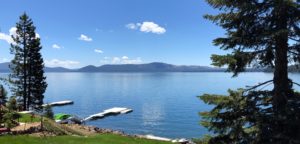
It’s amazing how one conversation can alter the trajectory of your future. This happened for me on June 22, 2022. Steve and I were having coffee in the western-facing nook of the cabin. The sun’s ascent into the crystal blue sky illuminated a glassy lake out back. Tall evergreens stood motionless around the smooth cobalt water. A lone osprey circled the cove in search of an early morning feast. The house was completely quiet.
“Ahhhh, the peace of the mountains,” I thought.
My short, dark blonde hair was disheveled from another sleepless night.
Steve’s health was in rapid decline. An unexpected emergency room visit six months ago was so intense that we didn’t think Steve would survive the weekend. I married this man knowing his body was a miraculous puzzle doctors put back together after a motorcycle accident. The twenty-eight reconstructive surgeries and countless metal parts beneath his skin took their toll on him over the years.
I jokingly called him high maintenance.
Only the recent scare was different. It was as though all of Steve’s physical maladies collided into one perfect storm. I wheeled him out of the hospital’s sliding doors as a shell of the man who went in.
His stroke eight weeks back only amplified his weakness. We knew every moment together was precious, and I cherished the time just being in each other’s presence.
I pulled my eyes away from the serene water and glanced in Steve’s direction. He was donning his usual attire. Plaid flannel pajama pants and the maroon Patagonia fleece he only took off when a wash was absolutely necessary. The fluffy lining of his camel-colored slippers was frayed at the edges thanks to years of our English Staffy using them as chew toys.
“What’s on your mind today, babe?” I asked, finally breaking the silence.
“You’re going to need some structure when I’m gone, Kym,” Steve said.
My eyes widened at his blunt delivery.
This was not abnormal for Steve. I’d always known him to speak his mind. This didn’t bother me, though, because his honest words were backed by an inescapable wave of compassion.
“I’m serious, Kym,” Steve went on in a soft tone. His hazel eyes looked into mine with deep love. We were soulmates, and I trusted his insights.
“I know you like to play and plan trips, and you’re at your absolute best when you get to be spontaneous,” Steve smiled as he said this. Then he took a deliberate sip of his piping hot coffee, cradling the navy mug in both hands and slurping as he did so. Many wives might cringe at such an abhorrent sound. I did the first few months of our marriage. Then, as the years went by, I grew to appreciate it as one of Steve’s sweet idiosyncrasies. After a decade of being so intimate, I knew
I couldn’t, and wouldn’t, try to change him.
I waited for Steve to continue.
“You know how I tease you about being an unruly balloon?” Steve asked with a smirk.
I smiled, knowing exactly what he meant. Steve often said that my enthusiasm for life was like a big red balloon.
His depiction of my personality was pretty accurate. I’m bright and energetic from the moment I get out of bed. My soul sinks under the weight of boring, repetitive tasks. I like to plan things on the fly, like taking a kayak-camping trip around Lake Tahoe or buying a Sprinter van to make travel easier. If my life were summed up in a motto, it would be, “It’s easier to ask forgiveness than permission.” Steve was quite the opposite. He was the frugal and logical voice in our partnership who would die by the principle, “Measure twice. Cut once.”
Over the years, we found a beautiful blend of groundedness and freedom together.
Oftentimes, Steve saw himself as the fingers holding the air of my red balloon in place. He believed that if I didn’t have someone, or something, to harness my energy, I’d end up swirling and twirling uncontrollably around the room.
I took a sip of my espresso before speaking.
“I know exactly what you mean,” I replied.
“Good,” he said, his voice getting more serious. “You’re going to need some structure in your life to keep you steady when I’m not around.”
I teared up at his words. I knew Steve’s transition was inevitable. The urgency of picking him up after a fall or having to give him a bath after an accident often pushed those thoughts into the recesses of my mind.
“The framework you choose is going to be unique, Kym,” Steve said. “I want you to find something to keep your spirits high, yet anchor you to reality at the same time.”
I nodded.
You’ve got many wonderful gifts to share with the world, girl,” he concluded. “Don’t let them get lost in grief when I’m gone.”
“I hear you,” I agreed, a salty tear gaining enough momentum to fall from the corner of my right eye and down my cheek.
“I’m not sure what that will look like for me,” I confessed, wiping my face.
I was terrified of what life would look like without him, and I couldn’t admit that out loud.
“You’ll figure it out, Kym,” Steve encouraged me softly. “You don’t have to have the answers now. When the time is right, you’ll know what to do.”
A SPARK OF INSPIRATION
Later that week, I had a spark of inspiration. I could use golf as the structure for my new life. Now I get that playing a game might not be the first antidote to grief that comes to mind for most people. Volunteering at the local animal shelter, serving meals to the homeless, or diving deeper into one’s career may seem like more practical options.
Yet, the lifestyle Steve and I crafted for the past ten years was anything but normal. We spent summers on the West Coast and winters in Florida. We traveled to each destination by vehicle, racking up over thirty cross-country treks in total. Our friends were scattered throughout the US, and even our work schedule―before Steve became ill―didn’t fit the usual nine-to-five.
Golf was the consistent thread woven through our nomadic lifestyle. It was also a sport with a very specific objective: play an 18-hole course using the fewest number of strokes possible. Within that goal, I would have to hit smaller targets along the way. Land in the fairway from the tee box on longer holes. Stick the green in regulation and putt in two strokes to hit par. On the shorter Par 3’s, get as close to the pin as possible for a good look at birdie.
I could use those micro-goals as points of focus while I traversed the mysterious unknown. In fact, it would serve me to go back to basics.
MY START WITH GOLF
My mind flashed back to the summer of 2009 when Steve first suggested I take up golf.
“Are you serious?” I asked him, not sure if he was simply joking around with me. Most of my youth was spent on the soccer field or softball diamond. My teen years were filled with volleyball, surfing, and ultimate frisbee. Golf seemed way too slow for my taste.
“Of course,” he answered. His eyes sparkled at his brilliant proposal.
The corners of my lips curled up as I awaited his reasoning.
“Golf is a hard sport,” he said. “It requires mental focus, stamina, and coordination. If just one element of your swing is out of sync, your shot will suffer. Plus, it’s outside, we can hop on a course anywhere, and it’s something we can both do together.”
This last factor was the real selling point for me. Given our age difference and Steve’s limited physical capabilities post-accident, we needed a joint hobby.
“I’ll give it a shot,” I said. The athlete in me was always up for a challenge. “Where are we going to play?”
We were currently in a mountain town with a population of 2,500. This tripled in the summer months, when folks came up from the Central Valley of California or the High Desert of Nevada to escape the heat. I figured there had to be one nearby.
“I was thinking of Mount Huff,” he said. “It’s a small nine-hole course over in Indian Valley. They’ve got a range so you can hit some balls before we play, and we can rent you some clubs when we get there.”
He paused for a moment, scratching his chin.
“I think I still have mine in the garage,” he concluded.
“I bet they’re older than me,” I teased him.
Steve was an academic who liked to golf. I’m not sure he’d call himself a golfer, given how few times he actually stepped foot on a golf course and how many animals were injured on the rare occasions when he did.
“They just might be,” he agreed, with a laugh. “Why don’t we go this afternoon? It’s such a pleasant day.”
An hour later…
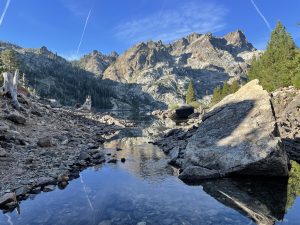
we meandered our way south on the tree-lined Highway 89. It was one of my favorite stretches of road in the entire country. Dense forests. High elevation views. Narrow corridors punctuated with granite walls. Sagebrush-covered gullies. Cattle herds grazing in open fields.
The jagged peak of Mt. Hough towered behind the course upon our arrival. The rustic conditions of the fairways didn’t bother me. I didn’t have any point of comparison.
At the range, Steve gave me simple tips on how to stand and hold the club. Given my excellent eye-hand coordination, I drilled my first nine-iron overshot 100 yards in a picturesque arc.
“Impressive,” Steve complimented me. “At that rate, you’re not going to need much of a warm-up.”
“Thanks, babe,” I responded with a spirited grin. “Beginner’s luck.”
I didn’t make solid contact with every ball, but by the bottom of my bucket, I felt confident enough to give the round a try.
We pushed our carts over patches of thistle and dried grass to the first tee box. I was relieved that we had the course practically to ourselves.
“Do you have the scorecard, Kym?” Steve asked.
I reached for the green and white sheet the attendant gave us in the pro shop and handed it to Steve. He looked so handsome in his gray slacks and teal shirt.
Steve leaned in to show me the card.
“We’re at hole 1,” he said, while pointing to the vertical row on the sheet, “and the pin is 179 yards from us.”
I looked up to see the white flag dancing lightly in the breeze. Thankfully, there was just grass between me and the pole.
Steve stepped up to hit first. He gave a braggadocious swagger as he addressed the ball. Then, in one graceful maneuver, he smacked the ball within fifteen feet of the green.
“Nice hit!” I cheered.
“Thanks,” he said proudly, “Now just hit the ball straight, like I did.”
“Sure thing, boss,” I replied, forcing my tee into the hardened earth.
I set up like Steve instructed and found footing that looked more like I was ready to receive a fastball than take a swipe with my three-wood. I pulled the club back in a steady fashion. Then, bam! I hammered the ball right in the direction of the pin.
“You outdrove me!” Steve exclaimed as my ball finally came to a halt. I was six inches in front of him and proud as punch to have struck the ball so well on my first attempt.
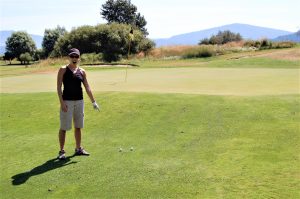
My first shot at Mt. Huff Golf Course
The rest of the game didn’t go that smoothly. Steve shanked a ball so far right that it almost decapitated a landscaper on break by the shed. I lost two sleeves of balls. Neither of us cared, though. We had a blast.
I was surprised to find that I really liked the game. Yet I knew that if I was going to take the game seriously, I needed to change a few things. I had to swap my hiking shoes and khaki shorts for a proper pair of softspikes and a skirt. And, I’d need to learn the fundamentals from a pro. So that’s what I did. I hired a coach. Participated in weekly clinics. Found a group of ladies who walked eighteen on Sunday afternoons. In a nutshell, I used my growth mindset from years of competitive training to continuously get better in this new realm.
BACK TO REALITY
The poignancy of the last memory brought me back to the present. Steve hadn’t joined me for a round of golf in years. Now he was dying, and I needed a plan. If I were to use golf as a way to move forward without him, I wanted to select 100 new golf courses to play.
Why new?
Because I understand how the brain works. Our eyes, along with our other senses, pick up information from the environment and send it to the brain for processing. To save energy, the brain searches the surroundings for anything familiar. This is beneficial when we like what we see because we feel good as a result. It’s easy to be happy when we like what we see.
But that’s not the reality of life. There are plenty of unpleasant situations we encounter. Watching Steve’s body deteriorate before my eyes was one such illustration. And when staring straight at something painful, it’s easy to become fearful, angry, or disappointed.
Thankfully, we’re not limited by our external environment. We can select our point of focus on purpose. We can deliberately find things that elicit a different emotion. Or, we can use our imagination to see beyond the moment and trigger a cascade of happy hormones into the body. That’s why visualization and mental rehearsal are great tools to increase golf performance. It’s why I use meditation as a way to practice inner calm.
Given that Steve and I just spent the last twelve years working and traveling side-by-side, life without him would be a jolting adjustment. I knew that forcing myself to focus on the good in tough times would be like putting a four-year-old on a full suspension mountain bike instead of a tiny frame with training wheels.
I needed to start slow. It was important to build some mental stability without Steve. To do this, I wanted to avoid the emotional landmines that would make me miss him even more. Familiar places, including golf courses we once played together, could do this. That’s why I became determined to pad my environment with new locations that wouldn’t trigger sadness
I took out my atlas and began to pen a list of possibilities. Pebble Beach was top on my list. Many others on the Monterey Peninsula were, too. I grabbed my phone and searched for the top golf courses in the country. Tracks in cities I wanted to visit made the cut. Then I thought of the wonderful places my family and friends called home. Phoenix, Arizona. Bend, Oregon. San Diego, California. Minneapolis, Minnesota. Each of these cosmopolitan regions were ripe with great options. I searched out the best courses in those areas and wrote them down.
As my list grew, so did my enthusiasm for such a bucket-list adventure. It sounded really fun, and I was ready to pack up the van right away.
And then I let out a heavy sigh.
I knew this experience would come at a cost; I wouldn’t have Steve by my side. With one hundred new golf dreams on the page, I tucked the document into the recesses of my desk drawer. Secretly, I hoped that I wouldn’t need that strategy for a long time.
GOLF ON THE ROAD
It didn’t take long for Steve and me to weave golf destinations into our excursions. We already deviated from the direct route between Chico and Sarasota to visit National Parks and drool-worthy bakeries. Now we had another reason to venture into unexplored territory. We played coastal gems like Gearhart Golf Links in Oregon and lakeside wonders like the Coeur d’Alene Resort Golf Course in Idaho. We combined camping with rounds at places like Green Lakes State Park in Fayetteville, New York, and Washakie Golf in North Branch, Michigan.
On one trip west, Steve and I made our way to Big Cedar Lodge in the Ozark Mountains of Missouri. I was instantly mesmerized by the attention to detail throughout the property. Take the iron railings, for example. The vertical posts matched that of a golf club, with driver heads at the base and intricate striping on grips at the top. The sensual curves at the end of each handrail also held an iron golf ball delicately in its curl. Delightful bronze sculptures, stunning vistas of Table Rock Lake, and chiseled limestone formations also dazzled me at every turn.
My favorite course on site was the Buffalo Ridge Springs Course. As we drove up to the clubhouse, we were greeted by an arching sign that read “Welcome fishermen, golfers, and other liars.” I laughed out loud, given the tall tales I’ve heard from both parties mentioned above.
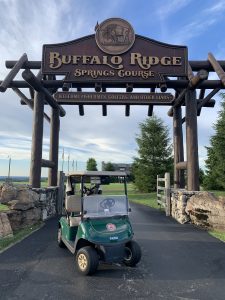
I was impressed with Tom Fazio’s design, which highlighted the lush, oak-dominated forests of the region. The track had other memorable features, too. There were buffalo skull tee markers―bronze and black and bone-chillingly cool. An actual herd of these gigantic mammals snorted alongside the fairway. Bears, gators, and coyotes were familiar to me by now. But bison? That was new. Plus, they served complimentary bison dogs at the turn. I’m not sure if these beasts were insulted by the gesture, but Steve sure wasn’t. He helped himself to at least two over the course of our five-hour round.
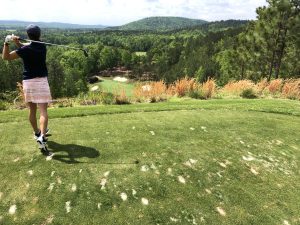
Another trek took us through the rolling hills of Alabama. We were on our way to the Robert Trent Jones Golf Trail when I heard a podcast mention Pursell Farms. The 3,500-acre property started a successful fertilizer business. Then they flipped their sales model from sending representatives on the road to building FarmLinks that would draw customers to them. Their most famous hole is a Par 3, known as Hang Time, with a 175-foot drop to the green. I couldn’t wait for the sweeping views of the Appalachian foothills from that tee box. As soon as Steve heard about their iconic Polish dogs, he was on board.
Only, when we arrived, the flora was at its springtime peak, and Steve’s allergies kicked in immediately. First came the headache. Then the runny nose and constant sneezing. He didn’t want me to miss out on the chance to play, so we teed off at our scheduled time slot. By the time we reached the signature fifth, Steve’s irritable bowel syndrome joined the party. So, despite my perfectly placed ball at the center of the green, which did get significant air time, Steve put the pedal to the metal in search of the closest bathroom. Needless to say, that round went unfinished.
PUTTING IT TOGETHER
There is a familiar saying that “the only constant in life is change.” Sometimes we face it head-on, as a challenge to overcome. Other times we avoid deviation from the familiar at all costs. More likely, we’re somewhere on the spectrum in between, depending on the type of shifts underway. If you’re in the midst of a large, disorienting transition like I was after my husband made his transition, then daily structure can be a lifesaver.
Instead of volunteering at a local animal shelter or diving deeper into work, I used golf as the format for my new life. And, in the space between each shot, I was able to find more focus and resilience than I ever thought possible. And while you might not select golf as your gateway to stability, the portal to a passionate existence awaits you in the space of change. I’m excited to show you how in this article (and the details of my upcoming book)!
Take Action Now:
-
- Download your copy of the PDF now (and get a sneak peek of the funny and interesting stories from the first half of my upcoming book).
- Check out The Focused Golfer Program, where I teach you the exact mindset and resilience techniques I use for peak golf performance.
- Send this article with a golfer you know!
Leave A Comment