


Change is a constant. Sameness is an illusion. We can lean into this fact when we’re more eager about the unknown ahead—a deliberate move, a promotion, a new baby on the way. But what about those unexpected changes we didn’t see coming? What about the bigger changes where fear supersedes enthusiasm? We can get paralyzed from taking action and fall into the role of a victim in our own lives. That’s why I want to talk about the elements of transformation today. Once you have greater clarity about how transformation works, you can manage the discomfort that inevitably comes with change. Better still, you can find stability, strength, and confidence to navigate the uncharted terrain of your future.
I figured this out firsthand on my own journey the past few years. This started out in 2021 when the 963,309-acre Dixie Fire threatened our community in Northern California. Our three-month evacuation seemed to be the worst of it, and we survived. However, in the process, Steve became very ill. Thanksgiving was spent in the hospital. So were many weeks that December. We didn’t think Steve would make it to 2022.
There were small and predictable changes that accompanied his illness. I became the sole driver in the family. I altered the types and amount of food I cooked for meals. More responsibilities as a caregiver arrived on my plate daily as Steve’s capacity diminished. This caused me to ask for help, simplify our lives, and delegate tasks beyond my control.
Then the big change arrived.
As much as Steve and I had talked about his imminent transition, there were no words that could have prepared me for life without him. The changes that followed were large and dramatic.
I felt like a caterpillar undergoing a complete metamorphosis. The crawling existence of my past, with Steve by my side, was a thing of the past. I was now in limbo. I was breaking down a previous existence and tucked away in a cocoon, trying to figure things out. Many times, this process seemed isolating and overwhelming.
That’s when Brené Brown’s latest book, Strong Ground, offered fresh terminology to describe my transformation. In this blog post, I’m going to pass on her ideas about change. Then I’ll share some mindsets and practices I use regularly to stay aligned while going through the process. I trust this information will support you as you go through bigger shifts in your own life. It’s also a way to have greater compassion for others who are experiencing a sizable transformation themselves.
Photo Credit: Gayatri Malhotra
QUOTES ABOUT CHANGE
Changes in life differ in size. Some are smaller, and more incremental in nature. Others are life altering on many levels all at once. Before I dive into how we might view these changes differently, here are some more quotes about transformation.
“All change is a miracle to contemplate.” —Henry David Thoreau, Walden
“In order to change skins, evolve into new cycles, I feel one has to learn to discard. If one changes internally, one should not continue to live with the same objects. They reflect one’s mind and psyche of yesterday. I throw away what has no dynamic, living use.” —Anaïs Nin, The Diary of Anaïs Nin (Vol 4)
“Change your conception of yourself, and you will automatically change the world in which you live. Do not try to change people; they are only messengers telling you who you are. Revalue yourself, and they will confirm the change.” —Neville Goddard, Your Faith is Your Fortune
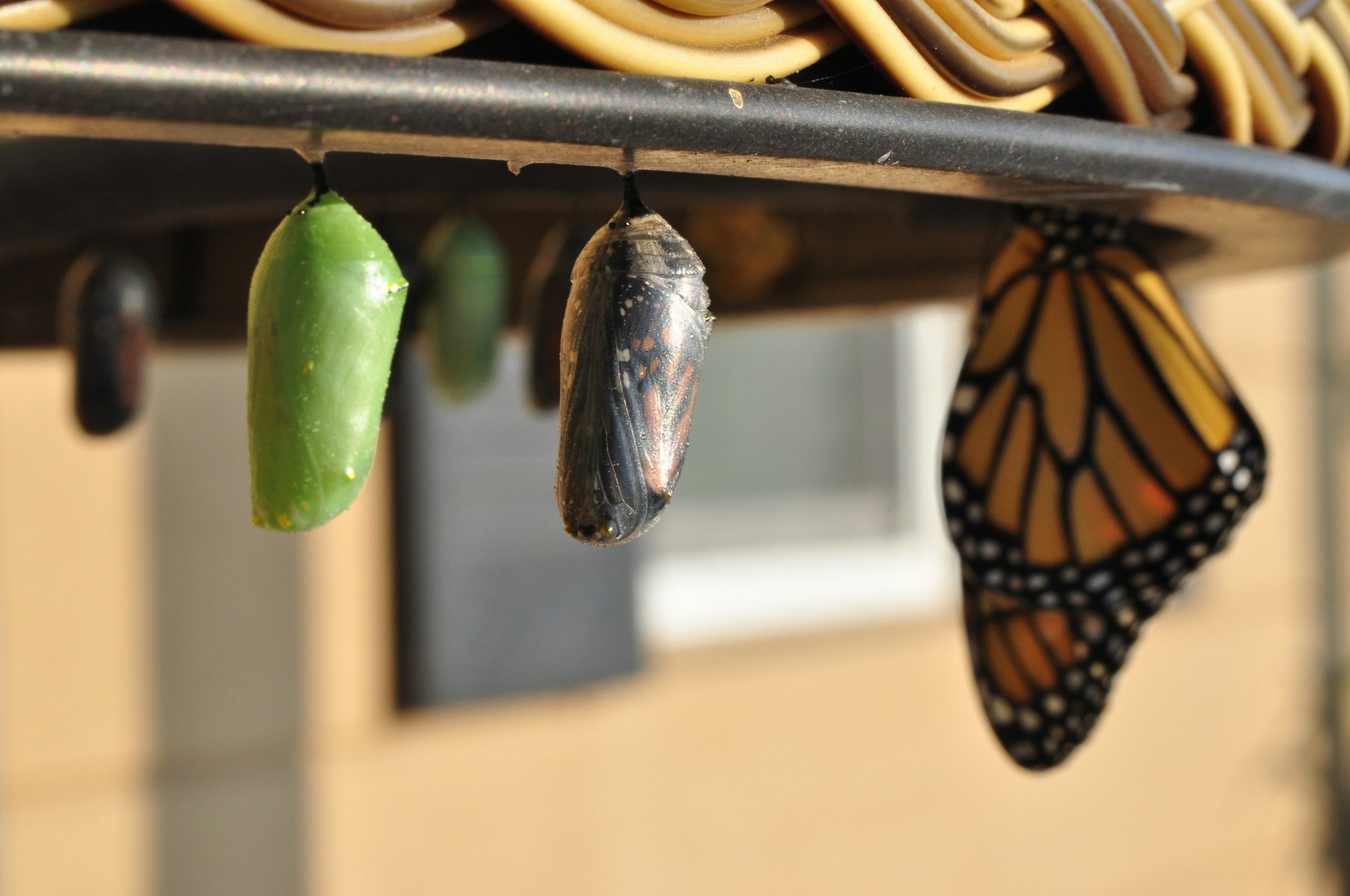
Photo Credit: Suzanne D Williams
“Change is only possible through movement.” —Aldous Huxley, The Art of Seeing
“The most difficult thing is the decision to act. The rest is merely tenacity. The fears are paper tigers. You can do anything you decide to do. You can act to change and control your life; and the procedure, the process, is its own reward.” —attributed to Amelia Earhart
“To love someone long-term is to attend a thousand funerals of the people they used to be. The people they’re too exhausted to be any longer. The people they don’t recognize inside themselves anymore. The people they grew out of, the people they never ended up growing into. We so badly want the people we love to get their spark back when it burns out; to become speedily found when they are lost. But it is not our job to hold anyone accountable to the people they used to be. It is our job to travel with them between each version and to honor what emerges along the way.” —Heidi Priebe, This Is Me Letting You Go
SMALL CHANGES VS TOTAL TRANSFORMATION
Daily life is full of incremental changes. We often adjust to these microfluctuations without a second thought. Just think of a newborn who grows into a toddler, then a child, a teen, and finally, a fully developed human. There are brilliant adaptations going on beneath the surface to allow for this evolution. As a parent, you witness these developments bit by bit. You pay attention to the nuances of the change, but you don’t try to rush to the final outcome.
This is a similar approach we use when trying new things as an adult. You start with the basics first and set your expectations accordingly. If you’re new to yoga, you don’t expect to put your foot behind your head the first time you get on the mat (unless you had that flexibility prior to beginning the practice). If you’re a new golfer, you don’t anticipate shooting par on your first round. Nor do you anticipate landing halfway across the world and being fluent in Italian after taking your first bilingual lesson. In all of these instances of change, you aim to aim to get better 1% at a time. That’s the long-term, sustainable approach.
But what about big events that trigger intense transformation?
These are the changes Brown refers to in her book, Strong Ground. She talks about these transformations from a business standpoint, yet the description of what happens in a corporation can be applied to our personal lives, too. It can happen with divorce, a move, a sudden change in financial status, an unexpected injury, or adding a member to your family. I experienced it with Steve’s departure.
While big transformations are rarer than gradual change, they do have very distinct features. Transformations of this scale are:
- Disorienting. The world can seem upside down.
- Immersive. They affect almost every area of your life.
- Demanding of your time, energy, and attention. It takes all of your inner resources to embody the new ways of being.
- Intense. This is why it requires so much of your time, energy and attention to find your balance in any given moment of the change.
When you find yourself or someone you know in this kind of transformation, it’s helpful to know the elements within these dramatic changes. This helps you identify where you are in the process. It also provides clarity about what step, or steps, you might take next to move forward.

Photo Credit: Brandi Caskey, Indigo Photography
THE ELEMENTS OF TRANSFORMATION
According to Brown, there are several components within a transformation. These are not linear in nature, although you can find more steadiness through each piece once you are aware of them.
(1) Deconstruction
Things are going to fall apart. Elements of a former existence will need to be dismantled to make way for the new. Life is going to be different, and many times shit’s going to break or shatter in the deconstruction phase.
Once you know this, you can more mindfully approach the breakdown. I did this after Steve’s death by disentangling our finances and selling our old home. I also took space away from old friendships and places we liked to travel. These steps were challenging. They were emotional. Yet, I knew I had the choice to be scared or clingy as I released those outdated patterns. Or, I could let the waves of sadness wash over me and feel empowered as I opened up space for my undetermined future.
(2) Complexity
The second element of transformations is their complexity. There are no black or white, right or wrong, all-or-nothing solutions. Many aspects of change are intertwined, so it’s important to be careful and strategic in the deconstruction.
(3) Hold Paradoxes
Merriam-Webster defines a paradox as “a person or thing having seemingly contradictory qualities.” Things can be bright or dark, light or heavy, close or distant, happy or sad, seen or unseen, steady or unsteady. Different subjects have a variety of these elements, often falling somewhere in the middle of these far ends of the spectrum. Our relationships do, too.
While I might have been lonely at times missing Steve, I felt connected to the people I met when sharing a round on my great golf adventure. At times, I felt incapable of organizing my future. Other times, I was skilled at making great decisions. Some friendships grew tighter during this period, whereas some disappeared entirely. All of this is okay. The more we accept diversity within the whole, the easier it is to find inner peace throughout a transformation.

Photo Credit: Doug Blesse
(4) Identify, and Protect, What’s Most Important
The fourth element of transformation is to save those aspects of your life that are most important. That is your foundation. When a wrecking ball destroys all of your walls, you want a solid base on which to rebuild. As you identify what matters most to you and decipher what is at your core, you can gain more clarity in the rebuilding process.
To distinguish what’s more important to you, ask yourself the following questions:
- Who am I, at the heart and soul level?
- What non-negotiable values drive my decision-making?
- What attitudes and behaviors matter most to me?
- What aspects of my life are central to my mission?
- What is my mission? Or do I have elements of a purpose that are visible now?
(5) Stand on your Foundation
The answers above illuminate your foundation. They give you a solid bedrock to stand on moving forward. The values, beliefs, attitudes, and relationships that matter most to you provide the steady ground from which to rebuild. When you feel shaky in a transformation, it helps to go back to basics. As my father-in-law always used to say, “Simplify your life until you’re back in control.” Knowing your foundation is key to this.
(6) Fear arises
When we’re afraid, territorial behavior emerges as a survival mechanism. I discovered this when selling our house in Florida. It was my long-time home with Steve and represented more to me than just a piece of property. I knew I didn’t want to live there. Yet, I got really scared to let it go. I passed up numerous offers because I was afraid of who I would be without that house. I felt afraid I would lose my identity, my sense of self, and my connection to Steve.
Once I became aware of this fear, I took steps to soften it. I forgave myself for past mistakes around the subject and made new choices from a broader perspective. This new vantage point helped me more quickly identify when fear surfaced again (because it has numerous times). Only now I don’t fight it. I use fear as an opportunity for growth in this transformation process.
 (7) Honor Strategies that are Working
This element of transformation is important because you don’t have to entirely rebuild your life from scratch. You’ve got a foundation. You also have strategies in place that served you well in the past. Identify those. Replicate those. Harness the power of your energy in those strategies to embody your greatest potential in your next chapter.
Steve and I wrote books as an effective teaching strategy. I knew I wanted to continue that once he was gone. That’s why I write daily. This practice has led to the most recent publication of Miracle on the Mountainside: A True Story of Tragedy Transformed into Life’s Greatest Gift. This, and other strategies like a meditation and yoga practice, continue to build positive momentum as I construct my new life.
(8) Get Honest Feedback Regularly
Transformation can seem like a lonely experience. Emotions can also take over and make it challenging to prioritize what matters most. That’s where honest feedback comes in. Let someone you trust into your inner circle. Whether this is a single person or a group of people, allow them to be a sounding board when you make decisions. You could choose a spouse, best friend, coach, or therapist. You might choose a team of friends and professionals alike to help you navigate the journey. Keep in mind that those relationships might change as time goes on. That’s all okay. The goal is to use the honest feedback from people you trust to maximize your energy before and during the action steps of your transformation.
TIPS TO NAVIGATE TRANSFORMATION
Now that you understand what a big change and the resulting transformations entail, here are some basic strategies to help you traverse the uncharted terrain. The reality is that things are going to be awkward for a while. There’s no way around it. I’ve found that it’s helpful to just be honest about my current condition and show up authentically. I’ve also incorporated these mindsets and practices to help me stay balanced.
Add Space to Your Life
Space is like the chrysalis for a caterpillar. In this pupa phase of metamorphosis, the creature disconnects from external activities to undergo a complete transformation. It literally becomes goo (like the deconstructive element of change) in order to rewire its DNA.
You, too, can create a cocoon-like environment for yourself by adding more space to your life. This space allows you to address the elements of transformation with greater awareness, grace, and ease. This might be more moments to yourself throughout the day or more scheduled time alone on your calendar. It could be declining invitations you’ve readily accepted in the past or delegating tasks and responsibilities to others for a while. It might even be a walk in nature. Decide what kind of space nurtures you and utilize more of it regularly.
Pay Attention to What’s Working
In the deconstruction phase of transformation, it can be easy to observe what’s not working. Only, in the chaos, you always have the choice of where you place your attention. Instead of focusing on what’s not working, it helps to deliberately look for things that are going right in the world around you.
Start this practice with a broad approach. Take some space and go outside. Look at the harmony of the Universe. The sun rose today without your effort, and it will set on its own as well. The seasonal changes of the trees are in perfect order, as are the movements of the stars in the sky and the waves in the sea. Take in this perfection with your eyes. Then smell the environment around you. Hear it. Sense it in as much detail as you can.
Even the heart beating in your chest and the breath moving in and out of your lungs are examples of this perfect coordination. To internalize this natural balance, incorporate simple breathing exercises into your routine. As you focus on what’s working, whether in your body or in the world at large, you’ll feel better in the moment. This opens the door for more of those good-feeling moments to flow into your experience.

Photo Credit: Jeremy Bishop
Ask for What you Want and Need
The reality is that people can’t read your mind. During a big transformation, they might feel uncomfortable with your change and become uncertain of how to best interact with you. Let them off the hook. Start to get clear on what you want and need. Then verbalize those requests to those around you in kind and succinct ways.
Some people will be like my good friend, who has called me every few weeks since Steve’s passing. She checks in on me and invites me to golf or take a walk when the weather is good. More often than not, I’ve said “no” to these opportunities. Yet, I graciously thank her and tell her how much her calls mean to me. I also request that she keep the invitations coming. They mean a lot to me. I feel seen and valued. And although she can’t comprehend my transformation entirely, she gives me hope that friendships will still be there when I emerge someday as a butterfly. Others might not ask how you need support at all. That’s alright. Simply be prepared for what you want and need in the moment so you can share those preferences in a mindful way.
Let Go of the Timeline
It’s human nature to want to pursue pleasure and avoid pain, and there can be a lot of discomfort during a transformation. This is normal since there are multiple changes being integrated into our systems all at once. To remain stable in a transformation, let go of your expectations around time. Release the need to know when a new “normal” will be established.
The butterfly’s emergence from the chrysalis is another great example of this. As it struggles to emerge, it builds strength and stamina. Any outside assistance to quicken the process can hinder the butterfly’s ability to function once out in the world. So, don’t rush things. Don’t set unrealistic limits on yourself. In fact, let go of some timelines altogether so that you don’t introduce unwanted stress or chaos into your already unsteady system.

Photo Credit: Brandi Caskey, Indigo Photography
PUTTING IT TOGETHER
The reality is that change is inevitable. Some changes are small and incremental. Others are big, intense, and all-consuming. We can approach this latter type of transformation with fear and uncertainty. Or, we can break down the elements of these large-scale changes so that we have confidence going through the process. A solid foundation of values and strategies helps, too, as do mindset shifts and habitual practices that support your evolving sense of balance.
Take Action Now:
- Think of a time you, or someone you know, went through a large-scale transformation. How does the information in this blog post alter your view of that experience?
- Download the blog in PDF form to integrate your knowledge about changes this week.
- Sample some pranayama, or breathing exercises, to stay grounded in the small or big changes of your life today.
- Check out my latest book, Miracle on the Mountainside. The short, compelling stories in this book highlight some dramatic changes that took place in Steve’s experience as well as the perspectives he discovered for inner peace through the challenges.






Leave A Comment